
Vegan cheese spread R&D in Sri Lanka: the retort iteration cycle
Buyer’s snapshot
- Sri Lanka’s processed-food exports rose 40.4% in 2025 as local manufacturers moved into higher-value formats, plant-based products among them (Sri Lanka Export Development Board, 2025).
- A home-kitchen vegan cheese recipe rarely survives retort unchanged: heat separates the oil and gelatinises the starch differently at 121 C than it does on a stovetop.
- Plan for two to four R&D sample iterations before the recipe locks, then a 6 to 10 week window from brief to first commercial batch.
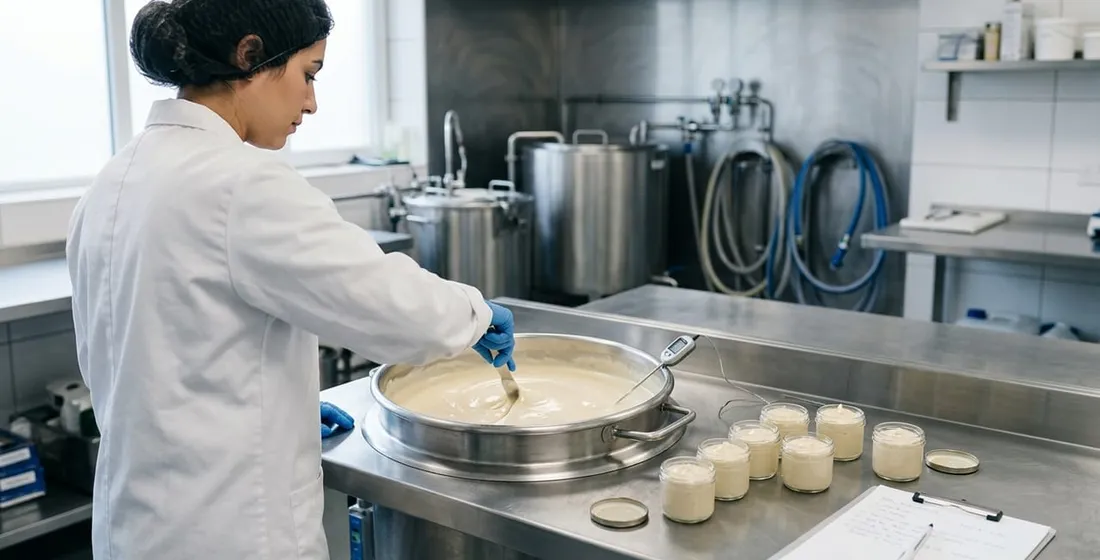
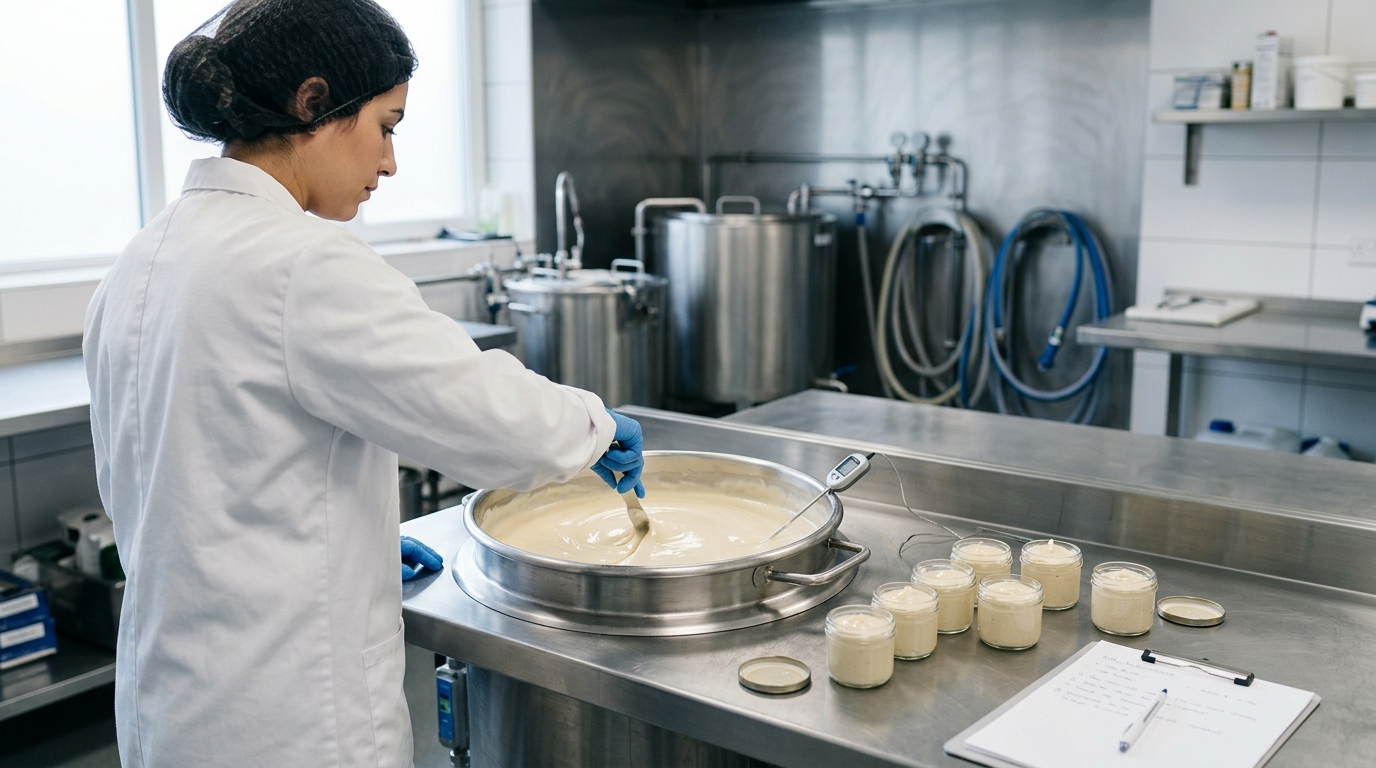
- Silk Foods Ceylon (SFC) runs an in-house R&D team and a non-dairy cheese line (cheese vat, cheese press, retort) at its Matale facility.
- The iteration table below shows what each sample round actually fixes.
Most local vegan cheese spreads in Sri Lanka start in a home kitchen or a small cafe batch. The recipe works. It tastes right, it spreads, it holds in the fridge. Then the brand wants it on a shelf: shelf-stable, in a glass jar that survives a warehouse and a delivery van with no cold chain. That is usually where the recipe breaks.
Retort sterilisation is not a hotter version of stovetop cooking. It is a different thermal process, and a vegan cheese that was never formulated for it tends to weep oil, thin out, or split the moment it leaves the autoclave. Silk Foods Ceylon (SFC), a contract manufacturer in Matale, sees this gap often enough that R&D, not production, is where most vegan-cheese inquiries actually begin.
Why a kitchen vegan cheese recipe rarely survives the retort
A vegan cheese spread is an oil-in-water emulsion held together by starch and an emulsifier. Research on plant-based cheese shows that oil loss during heating is a separate problem from emulsion stability: a formulation can hold in the fridge and still shed fat under heat (ScienceDirect, 2024). That is the trap a kitchen recipe falls into.
In a typical spread, coconut oil supplies the fat, a modified or tapioca starch gives body and the pull of a melt, and an emulsifier such as lecithin, xanthan gum, or carrageenan keeps the matrix from splitting. On a stovetop, the cook controls the heat by feel and serves the product cold or warm within hours. None of that holds in a sealed jar driven to commercial sterility.
Push too much coconut oil into the recipe and it separates under heat. Under-gelatinise the starch and the spread thins; over-gelatinise it and the texture turns gluey. The result is a product that looked perfect in a fridge test and arrives split and oily after retort. Fixing that is formulation work, not a tweak to the cooking time.
What does retort actually do to a vegan cheese spread?
Retort sterilisation seals the jar and heats it under pressure to commercial sterility. For a low-acid product like cheese, the benchmark is an F0 of at least 3 minutes at 121.1 C, the thermal dose that inactivates Clostridium botulinum spores (Sterilized Processed Cheese review, 2024). That dose is what earns an ambient shelf life with no refrigeration.
Commercial sterility for low-acid foods is reached between roughly 116 C and 132 C, and a correctly retorted product can hold 18 to 36 months at room temperature (Food Science and Nutrition, 2024). For a Sri Lankan brand, that is the difference between a chilled SKU restricted to a handful of cold-chain outlets and a shelf-stable jar that any of the major supermarket chains or a Sri Lankan e-commerce marketplace can stock without special handling.
The catch is that the same thermal load that delivers shelf stability is exactly what stresses the emulsion. So the R&D job is narrow and specific: build a formulation that still reaches an F0 of 3 or higher and looks, spreads, and tastes right when the jar comes off the line. Fill temperature and glass-jar headspace are part of that spec, not afterthoughts.
The iteration cycle: two to four samples, and what each one fixes
The R&D team at the Matale facility logs roughly 40 first-brief inquiries per quarter, and around 60% arrive without a stable formulation. For a retort-ready spread, the recipe almost always needs adjustment before it can be costed for a commercial run. The cycle is structured, not open-ended: most spreads lock in two to four sample rounds.
Each round has a job:
1. Baseline retort trial. The buyer’s kitchen recipe runs as-is in a small retort batch. The team measures what breaks: oil separation, texture, colour shift, and spread after sterilisation.
2. Emulsion and starch correction. The coconut-oil ratio is dialled back or rebalanced, the starch is swapped or blended, and the emulsifier load is tuned so the matrix holds through the heat.
3. Sensory and fill. Flavour is locked (classic, or with spices), post-retort spread and mouthfeel are confirmed, and fill temperature and headspace are set for the 300 g glass jar.
4. Confirmation batch, where needed. A near-commercial run verifies batch-to-batch consistency at the 1,500-jar size before the recipe is signed off.
The single most common gap is not the flavour. It is that the home-kitchen version was never adjusted for retort temperatures, glass-jar headspace, or consistency at 1,500 units rather than a single pot. Closing that gap is what the iteration count buys.
Kitchen recipe vs retort-ready spec
| Dimension | Home-kitchen recipe | Retort-ready spec |
|---|---|---|
| Thermal load | Stovetop, controlled by feel, served within hours | Sealed jar to F0 of 3+ at 121.1 C |
| Shelf life | Days, chilled | 18 to 36 months, ambient |
| Fat (coconut oil) | Set for taste and cold spread | Balanced to resist oil separation under heat |
| Starch / emulsifier | Whatever held in the fridge | Tuned to hold the matrix through sterilisation |
| Batch size | Single pot | Consistent at the 1,500-jar run |
| Compliance | None required at home | SLSI clearance + Sri Lanka Food Act on the retail jar |
How long does the cycle take, and what should the budget plan for?
Each sample iteration runs about 2 to 4 weeks: formulate, retort, assess, adjust. Two to four rounds is therefore the bulk of a 6 to 10 week window from brief to first commercial batch, the standard timeline when new R&D sits in front of production rather than an existing recipe going straight to the line.
The budget has three parts: the sample and formulation hours across the iterations, the retort trial runs, and a one-week lead for glass-jar tooling once the format is fixed. None of these is large on its own, but they are real line items, and planning the calendar around them matters more than shaving any single cost.
There is a point where the cycle is the wrong tool. A brand still changing its core flavour every week has not finished its kitchen-table testing, and starting paid retort trials on a moving target wastes both the samples and the calendar. A few more rounds of home testing first is the cheaper path.
From a locked recipe to the first commercial run
Once the spec locks, the same non-dairy cheese line that prototyped the spread (cheese vat, cheese press, and the retort) produces the first run. First-run MOQ for a 300 g glass-jar spread is 1,500 jars, about a half-day on the semi-liquid line, with the rest of the day reserved for changeover.
The retail SKU carries the local compliance floor. Silk Foods Ceylon is BRCGS- and FSSC 22000 V6-audited, with SLSI clearance and Sri Lanka Food Act 1980 compliance on every retail jar. SLSI clearance for a stable formulation typically takes 4 to 8 weeks, so a brand should plan a 6 to 10 week buffer between manufacturer QA sign-off and the target shelf date.
The category has room. Sri Lanka’s FMCG market is projected to grow at a 7.1% CAGR through 2032 (6Wresearch, 2025), and the global plant-based food market is forecast to expand at 8.67% a year to 2032 (Maximize Market Research, 2025). For a local brand, a shelf-stable vegan cheese spread that survives retort cleanly is a format that travels well across both retail and the diaspora gifting channel.
Frequently asked questions
How many R&D iterations does a retort-ready vegan cheese spread need?
Most lock in two to four sample rounds. The first is a baseline retort trial, the middle rounds correct the emulsion and starch so the spread holds under heat, and a final confirmation batch checks consistency at the 1,500-jar run size before the recipe is signed off.
Why does vegan cheese separate or weep oil when heated?
Because it is an oil-in-water emulsion, and research on plant-based cheese shows oil loss under heat is a separate problem from emulsion stability (ScienceDirect, 2024). Too much coconut oil or an under-tuned starch and emulsifier system lets the fat split out during retort.
Can Silk Foods Ceylon develop a vegan cheese spread recipe for a Sri Lankan brand?
Yes. R&D and NPD (Co-Development on the SFC brochure) is the in-house service for brands without a retort-ready recipe. The team typically runs two to four sample iterations, then moves the locked spec onto the non-dairy cheese line for the first commercial run.
What is the MOQ for a vegan cheese spread at Silk Foods Ceylon?
The first-run MOQ for a 300 g glass-jar spread is 1,500 jars, roughly a half-day on the semi-liquid line. Glass-jar tooling adds about a week of lead time once the format is fixed.
How long does it take to go from brief to first commercial batch?
Plan 6 to 10 weeks when a new recipe needs development first. Each R&D iteration runs about 2 to 4 weeks, and an SLSI clearance buffer of 4 to 8 weeks should sit in parallel before the retail shelf date.
How Silk Foods Ceylon can help
For local FMCG brands moving a vegan cheese spread from a kitchen recipe to a shelf-stable retail SKU, Silk Foods Ceylon (SFC) runs an in-house R&D team alongside a non-dairy cheese line and retort at its 10,000 sq ft cellular-manufacturing facility in Matale. Expect two to four sample iterations to make a recipe retort-ready, then a first-run MOQ of 1,500 jars (300 g glass) for the commercial batch. The facility is BRCGS- and FSSC 22000 V6-audited, with SLSI clearance and Sri Lanka Food Act compliance on every retail jar, and SLSI submission support sits inside the standard engagement. To brief a project, email b2b@esilkroute.com.lk or call +94 76 441 0389 / +94 76 918 5744.
Sources
- Sri Lanka Export Development Board (2025), “Food and Beverages Products Export Performance”, https://www.srilankabusiness.com/food-and-beverages/about/export-performance.html (retrieved 2026-06-03).
- Sterilized Processed Cheese: Principles, Technological Aspects, and Properties: A Review (2024), PubMed Central, https://pmc.ncbi.nlm.nih.gov/articles/PMC11942140/ (retrieved 2026-06-03).
- Jimenez et al. (2024), “Understanding retort processing: A review”, Food Science and Nutrition, Wiley, https://onlinelibrary.wiley.com/doi/full/10.1002/fsn3.3912 (retrieved 2026-06-03).
- “Fat stabilization techniques for the reduction of oil loss in high protein plant-based cheese” (2024), Food Hydrocolloids, ScienceDirect, https://www.sciencedirect.com/science/article/pii/S0268005X24006362 (retrieved 2026-06-03).
- 6Wresearch (2025), “Sri Lanka FMCG Market Outlook to 2032”, https://www.6wresearch.com/industry-report/sri-lanka-fmcg-market (retrieved 2026-06-03).
- Maximize Market Research via PR Newswire (2025), “Global Plant-Based Food Market to Surpass USD 54.41 Billion by 2032”, https://www.prnewswire.com/news-releases/global-plant-based-food-market-to-surpass-usd-54-41-billion-by-2032—driven-by-plant-based-protein—vegan-food-trends-mmr-statistics-302676473.html (retrieved 2026-06-03).
Written by the Silk Foods Ceylon Team. Silk Foods Ceylon (Pvt) Ltd. is a BRCGS- and FSSC 22000 V6-audited contract manufacturer in Matale, Sri Lanka, offering contract manufacturing, private labelling, co-packing, and in-house R&D for local Sri Lankan brand owners, FMCG companies, hotel and restaurant groups, and distributors. To brief a project: b2b@esilkroute.com.lk, +94 76 441 0389, or +94 76 918 5744.