
SLSI clearance for a private-label coconut jam: the 6-week submission window explained
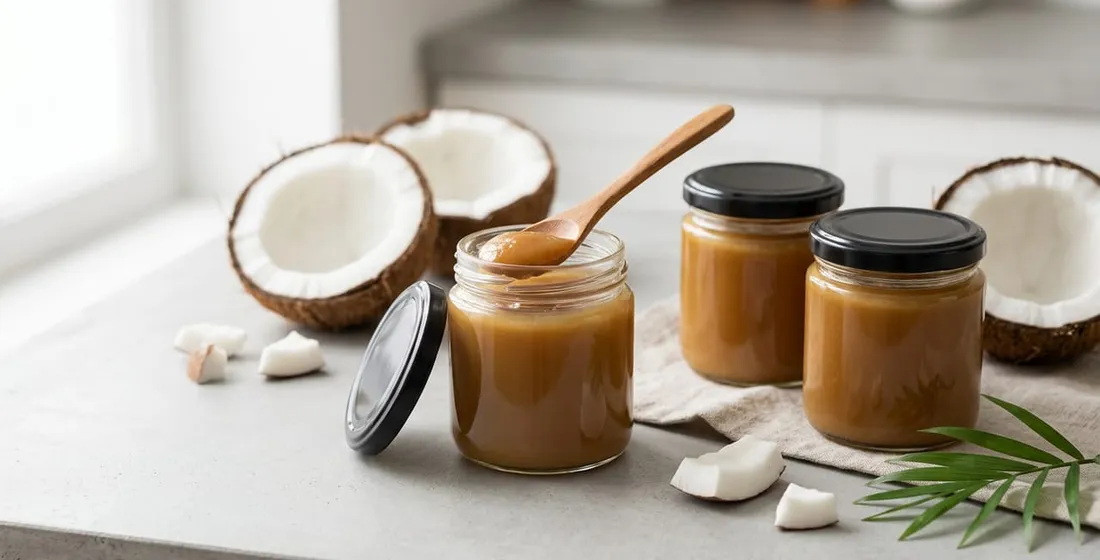
Founder's snapshot Sri Lanka's coconut exports topped US$1 billion in 2025, up more than 40% year on year, with kernel products the largest share (EDB / Coconut Development Authority, 2026); the local retail shelf is the same opportunity at home. A private-label coconut jam is a packaged food, so SLSI clearance gates the retail shelf. The submission window typically runs four to eight weeks for a stable formulation. Plan a six-to-ten-week buffer between manufacturer QA sign-off and your target shelf date. The buffer, not the recipe, is what most first launches underestimate. Silk Foods Ceylon (SFC) makes coconut jam (original, pineapple, cocoa, ginger, cinnamon) on a line that fills 3,000 jars a day, with a 1,500-jar first run and SLSI handled inside the engagement. |
A coconut jam is one of the easiest first products for a Sri Lankan F&B founder to fall in love with and one of the easiest to underestimate on compliance. The recipe is forgiving, the raw material is local and cheap, and the product sells a clear story. Then the first retailer asks for the SLS number, and the founder discovers that the gap between a working jar and a shelf-ready SKU is a certification process with its own calendar.
This post explains SLSI clearance for a private-label coconut jam in plain terms: what SLSI is, what the four-to-eight-week submission window actually contains, what the label law requires, and how working with a manufacturer that handles the submission shortens the path. Silk Foods Ceylon (SFC) produces coconut jam under private label and runs the SLSI step inside the engagement, so the process below is the one a founder actually walks through.
What SLSI clearance is, and why a coconut jam needs it
The Sri Lanka Standards Institution (SLSI) is the national standards body. It runs the product certification scheme that issues the SLS mark, and a compulsory inspection regime covering 122 items gazetted under the Imports and Exports Control Act (SLSI, 2025). For a locally made packaged food like coconut jam, SLSI certification is what a retail buyer treats as the floor: most established supermarket and marketplace channels expect it before a packaged food lists.
The practical point for a founder is that SLSI clearance is not optional paperwork bolted on at the end. It is the gate. A coconut jam that tastes excellent and looks beautiful still cannot reliably hold a shelf at a major supermarket chain or a packaged-food marketplace without it. Treating the submission as the first scheduled task, not the last, is the single habit that keeps a launch on time.
The submission window: what actually happens in those weeks
For a coconut jam with a stable formulation, the SLSI submission window typically runs four to eight weeks. That window covers the documentation review, product testing against the relevant standard, and the certification decision. It is not dead time a founder waits through; it is working time during which the formulation must stay locked, because a recipe change mid-submission resets the clock.
- Lock the formulation and the pack format (for a coconut jam, usually a 300 g glass jar) so the submitted product matches what will ship.
- Assemble the document set: product formulation, ingredient sourcing, the manufacturer’s food-safety certification, label artwork, and the test-sample batch.
- Submit to SLSI and provide the test samples drawn from an actual production batch, not a kitchen pilot.
- Allow four to eight weeks for review, testing, and the certification decision while the recipe stays frozen.
- Plan a six-to-ten-week buffer overall between QA sign-off and the target shelf date to absorb any query or re-test.
In 2025 SLSI tightened submission discipline on packaged-food clearance, which made the buffer matter more, not less. For a founder, the practical consequence is simple: the shelf date is set backwards from the submission, not forwards from the recipe. A jam ready in the kitchen in March is a jam on the shelf in May or June once the window and buffer are counted honestly.
What the Food Act label on a coconut jam must carry
Running parallel to SLSI is the Sri Lanka Food Act and its Food (Labelling and Advertising) Regulations 2022, brought into force from January 2024. The Act sets what the jar’s label must carry, and it is more than a name and a price. The label is part of what SLSI and a retail buyer both check, so it gets designed alongside the submission rather than after it.
Buyer's checklist: a compliant coconut jam label Product name in Sinhala, Tamil, and English Ingredient list in descending order by weight Allergen disclosure (a coconut jam commonly declares for the relevant allergen groups) Net weight in metric units with the prescribed font sizing Manufacturer name, address, and SLS number Best-before or expiry date in the prescribed format, plus storage conditions |
A coconut jam carrying a specific positioning claim, an Ayurvedic or wellness angle, for example, picks up a further requirement: Department of Ayurveda registration for that claim language. A plain culinary coconut jam does not need it. Knowing which bucket the product sits in before the artwork is drawn saves a redraw and a delay.
How a manufacturer shortens the path
The four-to-eight-week window assumes a stable formulation, an audited manufacturer, and a complete document set. Each of those is where a first-time founder usually loses time, and each is where working with an established contract manufacturer helps. SFC produces coconut jam under private label, original, pineapple, cocoa, ginger, and cinnamon among the variants, and handles the SLSI submission inside the engagement, so the founder is not learning the process from scratch under a shelf deadline.
The manufacturing economics are straightforward too. The semi-liquid line at the Matale facility fills around 3,000 jars a day, so a first private-label run at the 1,500-jar minimum is a half-day of production with the rest reserved for changeover. A stable formulation, a BRCGS- and FSSC 22000 V6-audited facility, and SLSI clearance and Sri Lanka Food Act compliance built into the engagement remove three of the most common sources of submission delay before the file is even opened.
Certification snapshot: Silk Foods Ceylon, Matale BRCGS-audited FSSC 22000 V6 (covers the full processing scope including semi-liquid spreads and jams) USDA Organic and EU Organic (per-SKU) SLSI clearance handled inside the engagement on every retail SKU Sri Lanka Food Act 1980 compliance built into the label Department of Ayurveda registration on relevant claim SKUs |
Where a coconut jam sits in the local market
The timing is favourable. Sri Lanka’s coconut exports passed US$1 billion in 2025, growing more than 40% year on year, with kernel products such as desiccated coconut, coconut milk, and coconut-based spreads the largest share (Sri Lanka Export Development Board, 2026). The same consumer pull that drives that export demand shows up on the local shelf, where a well-made coconut jam under a clear brand has a genuine retail story. The compliance work is what turns that story into a listing.
Frequently asked questions
How long does SLSI clearance take for a coconut jam?
For a coconut jam with a stable formulation the SLSI submission window typically runs four to eight weeks, covering document review, product testing, and the certification decision. Plan a six-to-ten-week buffer between QA sign-off and the target shelf date.
What documents does SLSI need for a private-label coconut jam?
The core set is the product formulation, ingredient sourcing, the manufacturer’s food-safety certification, compliant label artwork, and a test-sample batch drawn from actual production. A complete file at submission is the main thing that keeps the window short.
Does Silk Foods Ceylon handle the SLSI submission?
Yes. SFC produces coconut jam under private label and runs the SLSI step inside the engagement, so a founder does not learn the process from scratch under a shelf deadline. The facility is BRCGS- and FSSC 22000 V6-audited.
What is the minimum order for a private-label coconut jam?
A first private-label coconut jam run at SFC is 1,500 jars in the 300 g glass format, about a half-day on a line that fills 3,000 jars a day, with the rest of the day reserved for changeover.
How Silk Foods Ceylon can help
For a Sri Lankan F&B founder launching a private-label coconut jam, the relevant service at Silk Foods Ceylon is private labelling with the SLSI submission handled inside the engagement: an SFC coconut jam variant under your brand, with the certification path managed rather than left to you to navigate alone.
A first run is 1,500 jars in the 300 g glass format, a half-day on a line that fills 3,000 jars a day, with samples approvable in person at the Matale facility. The offer is credible because the facility is BRCGS- and FSSC 22000 V6-audited, with SLSI clearance and Sri Lanka Food Act compliance built into every retail SKU.
To brief a coconut jam launch, contact b2b@esilkroute.com.lk, +94 76 441 0389, or +94 76 918 5744.
Sources
- Newswire.lk (2026), “Coconut exports top $1 billion in 2025, up by 40%”, https://www.newswire.lk/2026/01/02/coconut-exports-top-1-billion-in-2025-up-by-40/ (retrieved 2026-06-04).
- Sri Lanka Standards Institution (2025), “Import Inspection Scheme and Product Certification (SLS)”, https://slsi.lk/web/en/services/import-inspection/ (retrieved 2026-06-04).
- Sri Lanka Export Development Board (2025), “Coconut and Coconut-Based Products”, https://www.srilankabusiness.com/coconut/ (retrieved 2026-06-04).
- U.S. Department of Agriculture Foreign Agricultural Service (2023), “Sri Lanka Food and Agricultural Import Regulations and Standards”, on the Food (Labelling and Advertising) Regulations 2022, https://www.fas.usda.gov/ (retrieved 2026-06-04).
- Further reading: Silk Foods Ceylon, “The certification stack for a Sri Lankan FMCG launch”, https://silkfoodsceylon.com/blog/certification-stack-sri-lankan-fmcg-launch.
Written by the Silk Foods Ceylon Team. Silk Foods Ceylon (Pvt) Ltd. is a BRCGS- and FSSC 22000 V6-audited contract manufacturer in Matale, Sri Lanka, offering contract manufacturing, private labelling, co-packing, and in-house R&D for local Sri Lankan brand owners, FMCG companies, hotel and restaurant groups, and distributors. To brief a project: b2b@esilkroute.com.lk, +94 76 441 0389, or +94 76 918 5744.
Appendix A: JSON-LD schema (for implementer)
{
“@context”: “https://schema.org”,\
“@graph”: [
{
“@type”: “BlogPosting”,
“headline”: “SLSI clearance for a private-label coconut jam: the 6-week submission window explained”,
“description”: “How SLSI clearance works for a private-label coconut jam in Sri Lanka: the documents, the four-to-eight-week window, the label law, and the buffer to plan before shelf date.”,
“datePublished”: “2026-06-01”,
“author”: {
“@type”: “Organization”,
“name”: “Silk Foods Ceylon”
},
“publisher”: {
“@type”: “Organization”,
“name”: “Silk Foods Ceylon (Pvt) Ltd.”
},
“mainEntityOfPage”: “https://silkfoodsceylon.com/blog/slsi-clearance-private-label-coconut-jam”\
},
{
“@type”: “Organization”,
“name”: “Silk Foods Ceylon (Pvt) Ltd.”,
“url”: “https://silkfoodsceylon.com”,\
“address”: {
“@type”: “PostalAddress”,
“addressLocality”: “Matale”,
“addressCountry”: “LK”
},
“hasCredential”: [
“BRCGS”,
“FSSC 22000 V6”,
“USDA Organic”,
“EU Organic”,
“SLSI”,
“Sri Lanka Food Act 1980 compliance”,
“Department of Ayurveda registration”
]
},
{
“@type”: “FAQPage”,
“mainEntity”: [
{
“@type”: “Question”,
“name”: “How long does SLSI clearance take for a coconut jam?”,
“acceptedAnswer”: {
“@type”: “Answer”,
“text”: “For a coconut jam with a stable formulation the SLSI submission window typically runs four to eight weeks, covering document review, product testing, and the certification decision. Plan a six-to-ten-week buffer between QA sign-off and the target shelf date.”
}
},
{
“@type”: “Question”,
“name”: “What documents does SLSI need for a private-label coconut jam?”,
“acceptedAnswer”: {
“@type”: “Answer”,
“text”: “The core set is the product formulation, ingredient sourcing, the manufacturer’s food-safety certification, compliant label artwork, and a test-sample batch drawn from actual production. A complete file at submission is the main thing that keeps the window short.”
}
},
{
“@type”: “Question”,
“name”: “Does Silk Foods Ceylon handle the SLSI submission?”,
“acceptedAnswer”: {
“@type”: “Answer”,
“text”: “Yes. SFC produces coconut jam under private label and runs the SLSI step inside the engagement, so a founder does not learn the process from scratch under a shelf deadline. The facility is BRCGS- and FSSC 22000 V6-audited.”
}
},
{
“@type”: “Question”,
“name”: “What is the minimum order for a private-label coconut jam?”,
“acceptedAnswer”: {
“@type”: “Answer”,
“text”: “A first private-label coconut jam run at SFC is 1,500 jars in the 300 g glass format, about a half-day on a line that fills 3,000 jars a day, with the rest of the day reserved for changeover.”
}
}
]
}
]
}
Appendix B: Open Graph and Twitter Card meta
| Tag | Value |
| og:title | SLSI clearance for a private-label coconut jam: the 6-week submission window explained |
| og:description | How SLSI clearance works for a private-label coconut jam in Sri Lanka: the documents, the four-to-eight-week window, the label law, and the buffer to plan before shelf date. |
| og:type | article |
| og:url | https://silkfoodsceylon.com/blog/slsi-clearance-private-label-coconut-jam |
| og:image | https://silkfoodsceylon.com/img/slsi-clearance-private-label-coconut-jam-hero.png |
| twitter:card | summary_large_image |
| twitter:title | SLSI clearance for a private-label coconut jam: the 6-week submission window explained |
| twitter:description | How SLSI clearance works for a private-label coconut jam in Sri Lanka: the documents, the four-to-eight-week window, the label law, and the buffer to plan before shelf date. |

Appendix C: Internal linking map
| Anchor text | Target URL |
| The certification stack for a Sri Lankan FMCG launch | https://silkfoodsceylon.com/blog/certification-stack-sri-lankan-fmcg-launch |
| Private labelling at Silk Foods Ceylon: a buyer’s guide | https://silkfoodsceylon.com/blog/private-labelling-silk-foods-ceylon-buyers-guide |
| Coconut product manufacturing in Sri Lanka | https://silkfoodsceylon.com/blog/coconut-product-manufacturing-sri-lanka |
| SLSI step-by-step for a first packaged-food submission | https://silkfoodsceylon.com/blog/slsi-step-by-step-first-packaged-food-submission |
| Contract manufacturing at Silk Foods Ceylon | https://silkfoodsceylon.com/blog/contract-manufacturing-silk-foods-ceylon |
| Specifying coconut oil grades for private-label retail SKUs | https://silkfoodsceylon.com/blog/specifying-coconut-oil-grades-private-label |
Appendix D: Editorial metadata
Day in 90-day plan: 19 (1 June 2026)
Cluster + spoke: P5 Certifications - SLSI clearance for a coconut jam spoke
Persona target: A primary (Sri Lankan F&B startup founder), D secondary
Template: cert-explainer-local
Image source: Higgsfield nano_banana_2 (job 71417e0b), QC attempt 1 pass; coconut jam smooth golden-brown, not oxidised
Humanizer scan: 0 em dashes, 0 forbidden phrases, 0 curly quotes, cert order BRCGS-before-FSSC verified
Internal links: 6 (P5 cert pillar, P2 private-label pillar, Coconut category pillar, SLSI step-by-step spoke, P1 pillar, coconut-oil spoke)
External citations: 4 (Local Tier 1/2: Newswire/EDB, SLSI, EDB; Global Tier 1: USDA FAS) + SFC first-party capacity/MOQ info-gain
Naming compliance: v1.1 honoured: no named retailers, marketplaces, or competitors