
Private-label coconut chips for a hotel minibar: flavour and packaging
HORECA snapshot
- Sri Lanka closed 2025 with a record 2.36 million tourist arrivals, up 15.1% year on year (SLTDA, Daily FT, 2025), which puts more in-room amenity and minibar spend in play than at any point since 2018.
- For a hotel group, a private-label coconut chip is a low-risk first SKU: it carries a local provenance story and survives an un-chilled minibar shelf.
- At Silk Foods Ceylon (SFC), a first private-label run sits at 1,500 jars or pouches per flavour, on a BRCGS- and FSSC 22000 V6-audited line with SLSI clearance on every retail SKU.
- The two decisions that make or break the SKU are the flavour ladder and the packaging barrier. The comparison table below sets both out.
Coconut chips are one of the few in-room snack formats that do three jobs at once: they read as local, they hold a clean-label story, and they sit on an un-refrigerated minibar shelf for months without a cold chain. That last point matters more than hotel buyers expect. Coconut kernel is roughly a third oil, and that oil is what decides whether the chip is crisp at month six or stale at week three. Get the flavour ladder and the packaging barrier right and a coconut chip becomes the easiest private-label SKU a hotel group can launch. Get the barrier wrong and it becomes a guest complaint.
Why coconut chips fit a hotel minibar programme
A minibar SKU has a narrow brief. It has to survive an ambient shelf, it has to justify a markup against a guest who knows supermarket prices, and it has to say something about where the guest is staying. A locally made coconut chip clears all three. Coconut sits at the centre of Sri Lanka’s food export story: coconut-based exports crossed USD 1 billion for the first time in 2025 and helped drive national exports to a record USD 14.4 billion (Newsfirst, 2025). A guest who has seen coconut palms on the drive from the airport understands the product on sight, which is most of the marketing already done.
The category is also growing rather than mature. The Sri Lanka coconut products market was tracking a 7.8% growth rate in 2025 (6Wresearch, 2025), with coconut chips riding the same clean-label and natural-snack demand that lifts the rest of the segment. For a hotel group, that means a coconut chip is not a tired choice, it is an on-trend one with a domestic supply base behind it.
The flavour ladder: how many variants, and which ones
The instinct on a first programme is to launch one flavour and see. The better move for a minibar is a tight ladder of three, because a minibar is a fixed display where variety does the selling that a salesperson would do elsewhere. Three covers the obvious guest preferences without splitting the production run into uneconomic batches.
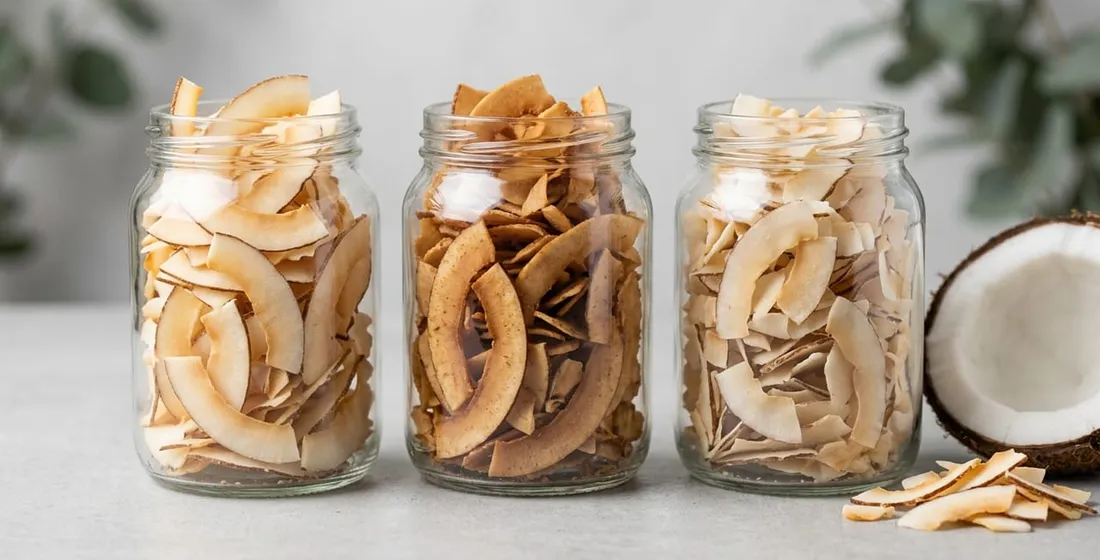
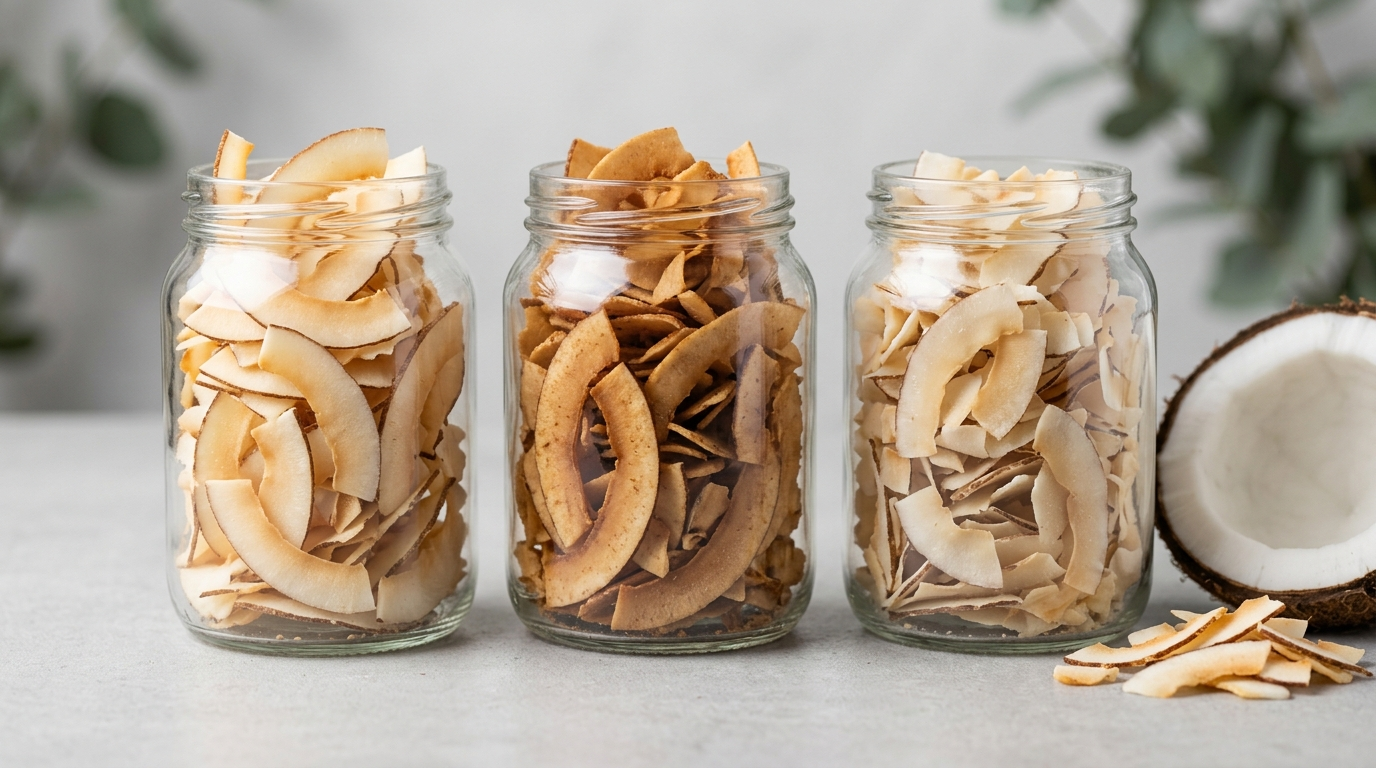
A workable ladder runs from plain to indulgent. Plain toasted is the anchor: lightly toasted coconut, nothing added, the clean-label option a health-minded guest reaches for. A lightly salted or salted-caramel variant is the crowd-pleaser that drives the most repeat pulls. A spiced variant, cinnamon or a mild chilli-lime, is the one that earns the provenance markup because it tastes specifically Sri Lankan and a guest cannot buy it at home. Beyond three, a minibar display gets crowded and each flavour’s batch volume drops below the point where the run is efficient.
| Variant | Role on the shelf | Flavour system | Production note |
|---|---|---|---|
| Plain toasted | Clean-label anchor | None; toast level only | Simplest run; sets the base spec |
| Salted or salted-caramel | Repeat-pull driver | Dry seasoning or sugar glaze | Glaze raises moisture; needs tighter seal |
| Spiced (cinnamon or chilli-lime) | Provenance markup | Dry spice blend | Carries the local story; strongest margin |
The flavour system has a packaging consequence that buyers often miss. A dry-seasoned chip behaves like the plain chip on the shelf. A glazed or caramel chip carries added moisture and sugar, which shortens its shelf life and demands a tighter oxygen and moisture barrier. The flavour decision and the packaging decision are the same decision.
Packaging: the barrier is the product
The reason a coconut chip fails on a shelf is almost never the recipe. It is oxygen. Coconut oil is high in medium-chain fats that oxidise, and oxidation is what turns a crisp, sweet-smelling chip into a soft, rancid one. Aluminium-foil-laminate barriers block oxygen, moisture and light, the three drivers of rancidity, and nitrogen flushing removes the oxygen already sealed inside the pack (Smart Weigh, 2025). For a minibar SKU that may sit un-sold for months, the barrier is not a finishing touch, it is the thing keeping the product saleable.
That sets up a real choice between a glass jar and a foil-laminate pouch, and a hotel programme can legitimately go either way depending on what the SKU is for.
Spec snapshot: coconut chip minibar pack
- Format options: 40 to 80 g foil-laminate stand-up pouch, or 100 to 200 ml clear glass jar
- Barrier priority: oxygen and moisture; nitrogen flush recommended for glazed variants
- Shelf life target: 6 to 9 months ambient with a foil barrier; shorter in clear glass
- First-run MOQ at SFC: 1,500 units per flavour
- Cert coverage: BRCGS- and FSSC 22000 V6-audited line, SLSI clearance, Sri Lanka Food Act-compliant label
A foil-laminate pouch wins on shelf life and cost per unit, and it is the right call for the working minibar where turnover is the goal. A glass jar wins on the gift-shop crossover: a guest who liked the chip in the room buys the jar in the lobby shop to take home, and glass carries that retail-gift value in a way a pouch does not. Several hotel groups run the same chip in both formats, pouch in the room and jar in the shop, off a single production run. The label changes; the chip does not.
One local brand at Silk Foods Ceylon ran exactly that split for a coconut SKU: a foil pouch for the minibar and a glass jar for the gift counter, both filled in one production block. The lesson from that run was not about the recipe. It was that putting a clear chip in clear glass under bright lobby lighting cut the practical shelf life, so the jar moved to an amber-tinted glass for the display copies while the pouch held the longer ambient life in the room.
The compliance layer: SLSI and the label
A private-label coconut chip going into a hotel programme is still a packaged food sold to a guest, so it sits inside the same local rules as a supermarket SKU. SLSI clearance is the gating step for any packaged food on a retail or hospitality shelf, and the Sri Lanka Standards Institution maintains the standards that coconut products are assessed against (SLSI, 2025). Coconut product exporters also register with the Coconut Development Authority, which matters the moment a hotel group wants to sell the same gift-shop jar to a departing guest as an export-style purchase (Coconut Development Authority, 2025).
The label itself has to meet Sri Lanka Food Act requirements: the trilingual conventions, the weight declaration, the allergen and ingredient disclosure. For a hotel buyer, the practical point is that the manufacturer carries this load inside a private-label engagement. A buyer who comes with a brand name and a flavour brief does not also need to become an expert in SLSI submission timelines. That is the manufacturer’s job, and planning it onto the calendar six to eight weeks ahead of the in-room launch date is the single most useful thing a hotel programme manager can do.
How the run actually books
The sequence is shorter than most hotel buyers expect, because a private-label coconut chip uses an existing SFC formulation rather than a new one. The flavour ladder is selected from the catalogue or specified as a light variation, the packaging format is locked, the label artwork is approved, and the run books. For an existing formulation the lead time runs in weeks, not months. If a buyer wants a bespoke flavour the chip does not already carry, an R&D step comes first to lock the seasoning and the toast level before the commercial run, which adds a sample-iteration window to the front of the schedule.
FAQ
What is the minimum order for private-label coconut chips at Silk Foods Ceylon?
A first private-label run at SFC sits at 1,500 units per flavour, whether the format is a foil pouch or a glass jar. That MOQ is set for a hotel group’s first commercial programme, not for export-scale volume, which keeps a three-flavour minibar ladder on a single production block.
How long do coconut chips last on a minibar shelf?
With an aluminium-foil-laminate barrier and a nitrogen flush, a coconut chip targets a 6 to 9 month ambient shelf life. Clear glass shortens that because light accelerates oxidation, so display copies often use amber glass (Smart Weigh, 2025).
Does a hotel coconut chip SKU need SLSI clearance?
Yes. SLSI clearance is the gating step for any packaged food sold on a retail or hospitality shelf in Sri Lanka, including an in-room minibar SKU. Within a private-label engagement at SFC, SLSI submission support sits inside the standard contract, on a BRCGS- and FSSC 22000 V6-audited line.
Can Silk Foods Ceylon develop a custom coconut chip flavour for a hotel brand?
Yes. Where a hotel wants a bespoke flavour the catalogue does not carry, the in-house R&D team locks the seasoning and toast level over a short sample-iteration window before the commercial run books, then produces it under the same cert stack as the standard SKUs.
How Silk Foods Ceylon can help
For hotel and restaurant groups running in-room amenity, gift-shop, or minibar SKU programmes, Silk Foods Ceylon (SFC) offers a private-label catalogue of 50+ ready-to-go products across spice blends, coconut SKUs, herbal teas, capsules, jams, and vegan formats. Custom branding is applied to existing SFC formulations; first-run MOQs sit at 1,500 jars or pouches per SKU, which keeps a multi-flavour minibar programme on a single production block. The Matale facility is BRCGS- and FSSC 22000 V6-audited, with SLSI clearance on every retail SKU. The adjoining plantation supports brand storytelling for sustainability-positioned hotel groups.
To brief an in-room or gift-shop programme, email b2b@esilkroute.com.lk or call +94 76 441 0389 / +94 76 918 5744.
Sources
- Sri Lanka Tourism Development Authority, Year in Review 2025. https://www.sltda.gov.lk/en/monthly-tourist-arrivals-reports-2025 (retrieved 10 June 2026)
- Daily FT, “Tourism arrivals grow by 15% to 2.36 m record high in 2025,” 2025. https://www.ft.lk/top-story/Tourism-arrivals-grow-by-15-to-2-36-m-record-high-in-2025/26-786582 (retrieved 10 June 2026)
- Newsfirst, “Sri Lanka Hits Record US$ 14.4 Billion in Exports; Coconut Products Cross US$ 1 Billion,” 26 November 2025. https://www.newsfirst.lk/2025/11/26/sri-lanka-hits-record-us-14-4-billion-in-exports-coconut-products-cross-us-1-billion (retrieved 10 June 2026)
- 6Wresearch, “Sri Lanka Coconut Products Market Outlook 2025-2031,” 2025. https://www.6wresearch.com/industry-report/sri-lanka-coconut-products-market-outlook (retrieved 10 June 2026)
- Sri Lanka Standards Institution, certified products and standards catalogue, 2025. https://www.slsi.lk (retrieved 10 June 2026)
- Coconut Development Authority of Sri Lanka, exporter registration and coconut product information, 2025. https://www.cda.gov.lk (retrieved 10 June 2026)
- Smart Weigh Packaging, “What role does nitrogen packaging play in preserving the quality of chips,” 2025. https://www.smartweighpack.com/a-news-what-role-does-nitrogen-packaging-play-in-preserving-the-quality-of-chips (retrieved 10 June 2026)