
Private Label Capsule SKUs for a Hotel Gift Shop in Sri Lanka
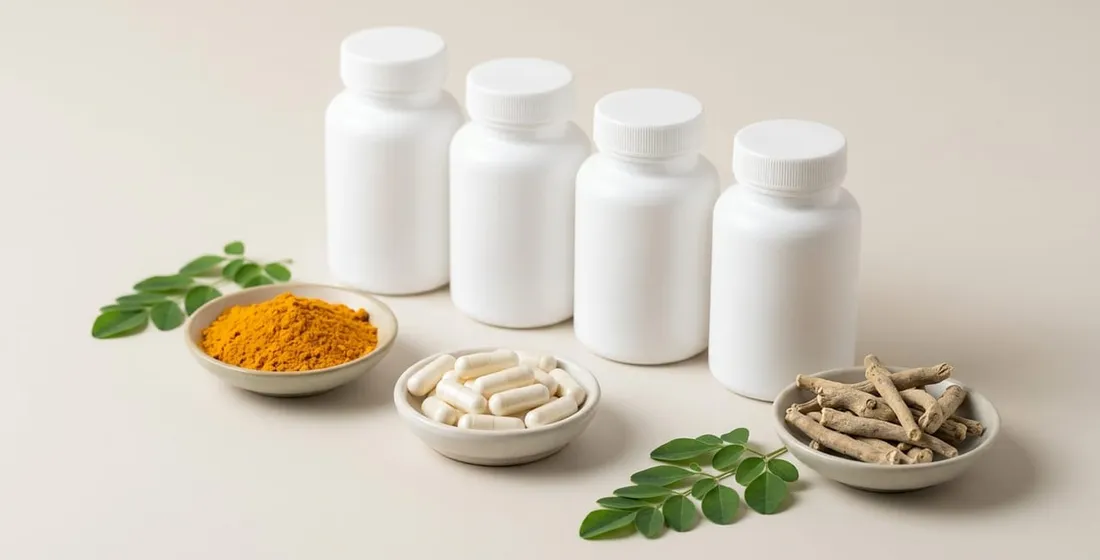

Private Labelling Capsule SKUs for a Hotel Signature Gift Shop
HORECA snapshot • Sri Lanka welcomed a record 2.36 million tourists in 2025, up 15.1% on 2024 (Sri Lanka Tourism Development Authority). That footfall passes through hotel gift shops daily. • A branded capsule range lets a hotel sell its own name to a guest already paying for an Ayurvedic spa stay, not just a generic souvenir. • Silk Foods Ceylon (SFC) private-labels capsule SKUs from a 180-bottle minimum on a BRCGS- and FSSC 22000 V6-audited line in Matale. • See the MOQ ladder and the certification matrix below before briefing a programme. |
Sri Lanka’s luxury and boutique hotel groups already run private-label SKU programmes for in-room amenities, gift-shop retail, and spa counters. Tea, spices, and coconut products are the usual range. The category most hotels overlook is wellness capsules, even though a guest checking out of a five-night Ayurvedic stay is about the most receptive supplement buyer a brand will ever meet. The barrier was never demand. It was that branding a capsule SKU sounds like a pharmaceutical project, and most procurement teams assume the minimum order is far too large for a single gift shop to absorb. Neither assumption holds.
What private labelling a capsule SKU actually involves
Private labelling a capsule SKU means a hotel group puts its own brand on a finished supplement that the manufacturer already produces and has cleared for the local shelf. At Silk Foods Ceylon (SFC), the private-label capsule catalogue covers more than a dozen single-herb SKUs, encapsulated and bottled at the Matale facility from a 180-bottle minimum per SKU. This section sets out where private labelling differs from developing a capsule from scratch.
The distinction matters for budget and timeline. Private Labelling (Our Product to Your Brand, in the SFC brochure) puts the hotel’s label on an existing SFC formulation. The hotel supplies the brand and the story; SFC supplies the formulation, the encapsulation, the bottle, the label, and the certification chain. There is no recipe development to pay for and no sample-iteration cycle to wait through.
Developing a capsule the hotel cannot find in the catalogue is a different service: R&D and NPD (Co-Development on the SFC brochure), where the in-house team formulates against a brief before the SKU goes to production. For a gift-shop programme, that step is rarely needed. The catalogue already holds the herbs a Sri Lankan wellness shelf sells, so most hotel ranges launch straight off private labelling.
Why wellness capsules fit the hotel gift-shop shelf
Wellness tourism is a USD 894 billion global market that grew 13.8% in 2024 and is forecast to expand about 9% a year to 2029 (Global Wellness Institute). A Sri Lankan guest who books an Ayurvedic treatment or a yoga retreat is already inside that spend. A branded capsule range converts a single spa visit into a product the guest carries home and reorders.
The numbers behind the local opportunity are large. Sri Lanka’s 2.36 million arrivals in 2025 generated tourism earnings of more than USD 3.2 billion, the highest on record (Daily FT, 2026). A meaningful share of those guests pass through a gift shop on the way out, and the gift shop is one of the few hotel touchpoints that earns a retail margin rather than a room rate.
Capsules suit that shelf better than most formats. They are small, light, and shelf-stable, with no cold chain and no spill risk. A guest can carry several bottles home in hand luggage, which a jar of coconut jam or a bottle of oil cannot match. Once home, the same guest can reorder through the hotel’s website or a diaspora gifting channel, so a single gift-shop sale can become a recurring one.
What is the MOQ for a private-label capsule SKU?
The first-run minimum for a private-label capsule SKU at Silk Foods Ceylon is 180 bottles per SKU, among the lowest in the category. The capsule line runs 100,000 capsules per single shift and up to 200,000 a day, so a multi-SKU hotel range fits inside one production block. For a gift shop testing three signature SKUs, that is 540 bottles in total, not a pharmaceutical-scale commitment.
A 180-bottle run at a 60-count bottle is roughly 10,800 capsules per SKU, a fraction of a single shift on the line. The floor sits there because of encapsulation changeover and bottling setup, not because of raw-material volume. For a hotel, the low minimum is the point: a gift shop sells slowly and seasonally, so the risk of a first run has to stay small. The table below shows how the maths scales across a starter range.
Private-label capsule programme: first-run maths for a hotel gift shop
| Range | Bottles (180 per SKU) | Capsules (60-count) | What it suits |
| 1 signature SKU | 180 | 10,800 | A single hero product, such as a spa-counter calm or sleep blend |
| 3-SKU starter range | 540 | 32,400 | A gift-shop wellness shelf across energy, calm, and immunity |
| 5-SKU full range | 900 | 54,000 | A multi-property group standardising one catalogue |
How a hotel signature capsule range gets built
Building a hotel signature capsule range runs from SKU selection to a shelf-ready bottle in roughly six to ten weeks, most of it regulatory buffer rather than production. Silk Foods Ceylon handles encapsulation, bottling, labelling, and the SLSI submission inside a standard private-label engagement. The steps below show where a hotel procurement team makes the decisions.
1. Choose SKUs from the SFC private-label capsule catalogue and confirm the gift-shop positioning for each.
2. Approve label artwork: the hotel brand plus the mandatory Sri Lanka Food Act elements (tri-lingual name, net count, ingredient and allergen lines, manufacturer details).
3. Lock the bottle format and capsule count, typically a 60-count white or black bottle.
4. Clear SLSI for the SKU, and register any Ayurvedic-claim SKU with the Department of Ayurveda in parallel.
5. Run the first production block and dispatch to the property or the central gift-shop store.
One boutique hotel group co-manufacturing at SFC started with a single 180-bottle pilot of a turmeric capsule for its spa counter in 2024. By early 2026 the range had grown to three signature SKUs across several properties on a single monthly block. The unlock was not price. It was that one certification stack and one label template carried every new SKU without re-auditing the manufacturer, so each addition was a scheduling decision rather than a fresh compliance project.
What certifications does a hotel gift-shop capsule SKU need?
A packaged supplement on a Sri Lankan gift-shop shelf needs SLSI clearance and Sri Lanka Food Act 1980 label compliance at the floor, plus Department of Ayurveda registration for any SKU carrying an Ayurvedic claim. A BRCGS- and FSSC 22000 V6-audited manufacturer clears hotel-group procurement faster, because finance and food-safety leads gate on the audit chain before they look at price.
The order in which a hotel team should read the stack runs from the international standards down to the local floor. BRCGS is the higher international food-safety standard and the strongest procurement reassurance, including for any export step a group might take later. FSSC 22000 V6 is the GFSI-recognised audit most procurement teams ask for on the manufacturer. SLSI clearance and Sri Lanka Food Act 1980 compliance are the local requirements every retail SKU needs. Department of Ayurveda registration, under the Ayurveda Act No. 31 of 1961, is the parallel step for any capsule making a traditional Ayurvedic claim.
Certification matrix for a private-label capsule SKU
| Certification | What it covers | Who gates on it |
| BRCGS | Higher international food-safety standard; premium procurement reassurance | Hotel finance and procurement; any later export step |
| FSSC 22000 V6 | GFSI-recognised food-safety audit on the manufacturer | Hotel-group and retail procurement |
| USDA Organic / EU Organic | Per-SKU organic certification where the herb supports it | Export-curious groups; a differentiation signal on the shelf |
| SLSI | Local retail and gift-shop shelf eligibility | Every Sri Lankan packaged-food SKU |
| Sri Lanka Food Act 1980 | Tri-lingual label, allergen disclosure, weight, manufacturer details | Statutory; every retail SKU |
| Department of Ayurveda (Act No. 31 of 1961) | Right to carry an Ayurvedic claim on the label | Any Ayurvedic-claim capsule SKU |
Choosing the herbs for a signature range
The SFC capsule catalogue maps cleanly onto how a gift-shop shelf is merchandised. Ashwagandha and Gotukola sit in the calm and sleep space that a spa guest gravitates to. Turmeric and Moringa anchor an immunity and daily-wellness position. Ginger and Triphala cover digestion, the most common request after a rich holiday menu. A three-SKU range usually picks one from each group; a five-SKU range adds a property’s signature herb.
Sourcing sits close to the line. Hapugasyaya is in the Matale spice belt, so when a new batch of turmeric or ashwagandha raw material is ordered from a local supplier, sample turnaround can run within the same week, and the adjoining plantation grows fresh herbs for R&D pilots. For a hotel group positioning a range on Sri Lankan provenance, that proximity is a real story rather than a label claim.
The demand backdrop is growing. The global herbal supplements market is projected to reach about USD 201 billion by 2035 at a 7.6% annual rate, with Asia-Pacific the fastest-growing region (Future Market Insights, 2025). For a Sri Lankan hotel sitting at the source of the herbs, a branded capsule range is a way to capture part of that demand at the point a guest is most willing to buy.
Frequently asked questions
What is the private-label MOQ for capsules at Silk Foods Ceylon?
The first-run minimum is 180 bottles per SKU, among the lowest in the category. The Matale capsule line runs 100,000 capsules per single shift and up to 200,000 a day, so a multi-SKU hotel range fits inside one production block rather than several separate runs.
Can a hotel group brand its own wellness capsule range?
Yes. Through Private Labelling, Silk Foods Ceylon applies a hotel’s brand to existing capsule formulations from its catalogue of 50-plus ready-to-go SKUs. The hotel supplies the brand and label artwork; SFC supplies the formulation, encapsulation, bottle, and SLSI submission.
Do Ayurvedic capsules need Department of Ayurveda registration in Sri Lanka?
Yes. Any capsule carrying a traditional Ayurvedic claim is registered with the Department of Ayurveda under the Ayurveda Act No. 31 of 1961, in parallel with SLSI clearance. SKUs sold purely as food supplements without an Ayurvedic claim follow the SLSI and Sri Lanka Food Act pathway alone.
How long does it take to launch a private-label capsule SKU?
Plan six to ten weeks from brief to shelf-ready bottle. Most of that window is the SLSI and Department of Ayurveda regulatory buffer, not production. The encapsulation and bottling run itself fits inside a single production block on a line rated at 200,000 capsules a day.
Is the Silk Foods Ceylon facility audited for capsule production?
The Matale facility is BRCGS- and FSSC 22000 V6-audited, with SLSI clearance on every retail SKU. The encapsulation line is rated at 100,000 capsules per single shift and 200,000 a day, with Department of Ayurveda registration on the relevant Ayurvedic-claim SKUs.
How Silk Foods Ceylon can help
For hotel and restaurant groups building a gift-shop or spa-counter wellness range, Silk Foods Ceylon (SFC) private-labels capsule SKUs from a catalogue of more than a dozen single-herb formulations, with custom branding applied to existing SFC recipes. First-run minimums sit at 180 bottles per SKU, so a three-SKU signature range is roughly 540 bottles on a single production block. The Matale facility is BRCGS- and FSSC 22000 V6-audited, with SLSI clearance on every retail SKU and Department of Ayurveda registration on Ayurvedic-claim SKUs. The adjoining plantation in the Matale spice belt supports a provenance story for groups positioned on Sri Lankan wellness.
To brief an in-room, spa-counter, or gift-shop programme, email b2b@esilkroute.com.lk or call +94 76 441 0389 / +94 76 918 5744.
Sources
• Sri Lanka Tourism Development Authority (2026), ‘Year in Review 2025’, https://www.sltda.gov.lk/ (retrieved 2026-06-06).
• Daily FT (2026), ‘Tourism arrivals grow by 15% to 2.36 m record high in 2025’, https://www.ft.lk/top-story/Tourism-arrivals-grow-by-15-to-2-36-m-record-high-in-2025/26-786582 (retrieved 2026-06-06).
• Global Wellness Institute (2025), ‘The Global Wellness Economy Hits a Record USD 6.8 Trillion’, https://globalwellnessinstitute.org/industry-research/the-global-wellness-economy/ (retrieved 2026-06-06).
• Future Market Insights (2025), ‘Herbal Supplement Market Size, Trends & Forecast 2025 to 2035’, https://www.futuremarketinsights.com/reports/herbal-supplements-market (retrieved 2026-06-06).
• Department of Ayurveda, Ministry of Health (Ayurveda Act No. 31 of 1961), ‘Regulation of Local Ayurveda Drugs / Products Registration’, https://ayurveda.gov.lk/ (retrieved 2026-06-06).
• Further reading: Sri Lanka Standards Institution, packaged-food certification framework, https://www.slsi.lk/ (retrieved 2026-06-06).
Written by the Silk Foods Ceylon Team. Silk Foods Ceylon (Pvt) Ltd. is a BRCGS- and FSSC 22000 V6-audited contract manufacturer in Matale, Sri Lanka, offering contract manufacturing, private labelling, co-packing, and in-house R&D for local Sri Lankan brand owners, FMCG companies, hotel and restaurant groups, and distributors. To brief a project: b2b@esilkroute.com.lk, +94 76 441 0389, or +94 76 918 5744.