
Co-Packing Kraft Pouches in Sri Lanka: 250 g to 1 kg Economics
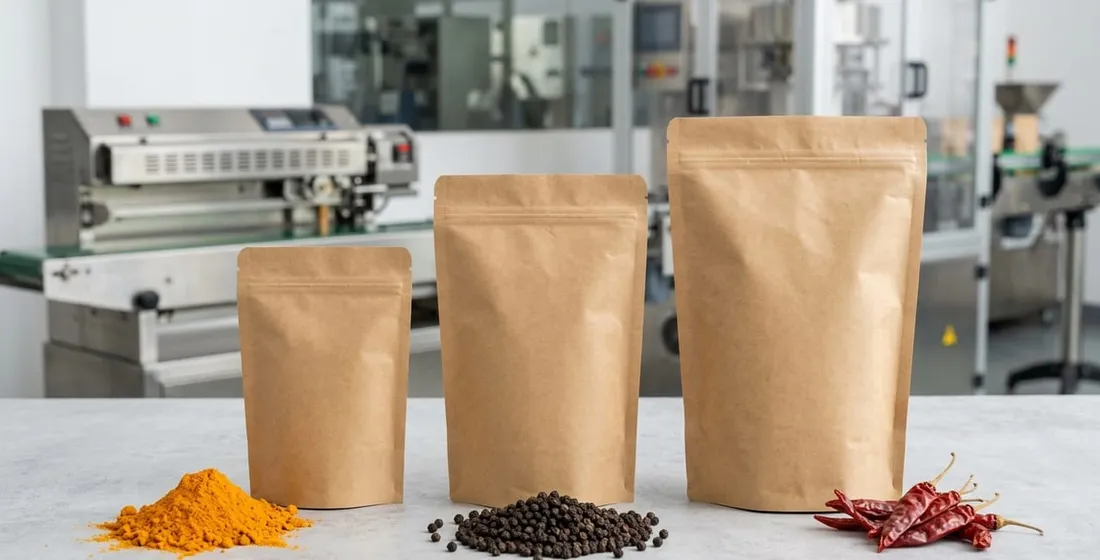

Co-packing kraft pouches for ethnic-grocery distribution: 250g, 500g, and 1kg format economics
Buyer's snapshot • Modern trade held roughly 22% to 25% of Sri Lanka's retail market share as of 2024 (Ceylon Today); neighbourhood grocers, spice merchants, and ethnic-grocery counters carry the rest. • That channel buys spice in 250 g, 500 g, and 1 kg kraft pouches, not 40 g shelf jars, and it reorders weekly. • Silk Foods Ceylon (SFC) co-packs buyer-supplied bulk into kraft pouches from 50 g to 1 kg on a BRCGS- and FSSC 22000 V6-audited line, and a consolidated multi-SKU run typically fits a one-day production block. • The format table below shows where packaging cost per kilogram actually lands. |
Roughly three out of four grocery rupees in Sri Lanka are still spent outside the supermarket chains. Modern trade held about 22% to 25% of national retail market share as of 2024 (Ceylon Today, “Navigating the Modern Trade Landscape in SL”); the rest moves through neighbourhood grocers, dedicated spice merchants, wholesale counters, and the ethnic-grocery shops that serve a particular cuisine or community.
That channel does not buy 40 g shelf jars. It buys spice in 250 g, 500 g, and 1 kg kraft pouches, paid for in cash and reordered weekly. For a distributor converting imported or locally milled bulk into stock those shelves will take, the decision that sets the margin is not the brand. It is the pouch size.
What does co-packing into kraft pouches actually cover?
Co-packing means the buyer supplies finished goods, bulk spice in this case, and the manufacturer packs, seals, and labels them into retail-ready formats. Silk Foods Ceylon runs brown and white kraft pouches at 50 g, 100 g, 250 g, 500 g, and 1 kg, with window options, on a BRCGS- and FSSC 22000 V6-audited line in Matale.
Co-Packing (you provide Finished Goods and we pack, per the SFC brochure) sits at the back end of the production chain. The spice is already milled, blended, or whole. What the distributor needs is the conversion step: filling to declared weight, heat-sealing, labelling, and carton packing. The Matale line runs a form-fill packing machine for free-flowing powders and whole spice, with band and vacuum sealers for the formats that need them.
Lead time is the shortest of any SFC service: typically 1 to 2 weeks from the day the goods arrive at the facility. A consolidated run of several SKUs usually fits a single day on the line. The full workflow from intake to dispatch is covered in the co-packing bulk-to-retail guide for distributors and importers.
The format economics: 250 g, 500 g, and 1 kg compared
Kraft pouch economics follow one rule: the film, filling, and labour cost of a pouch changes far less than the weight inside it. Packing 100 kg of spice into 250 g pouches means 400 fills, seals, and labels. The same 100 kg in 1 kg pouches means 100. Packaging cost per kilogram falls steeply as the format grows.
The realised price moves the other way. A 250 g pouch earns the highest price per kilogram because it sells at an entry price point a shopper will try without much thought. A 1 kg pouch earns the lowest because its buyer is a caterer, a small eatery, or a wholesale counter comparing it against loose bulk. The margin question is never which format is cheapest to pack. It is which format the target shelf reorders fastest.
Kraft pouch format economics for a spice co-packing run
| Format | Units from 100 kg | Packaging and labour cost per kg | Where it sells | What it earns |
|---|---|---|---|---|
| 250 g | 400 pouches | Highest (four fills per kg) | Neighbourhood grocers, trial purchase, gifting add-ons | Highest realised price per kg, smallest cash outlay per unit |
| 500 g | 200 pouches | Mid | Spice merchants and ethnic-grocery counters, the repurchase default | Balanced realisation and rotation |
| 1 kg | 100 pouches | Lowest | Wholesale counters, caterers, small eateries | Lowest realised price per kg, fastest kilogram throughput |
Most distributor programmes at SFC land on a two-format or three-format split of the same spice: 250 g for trial and urban grocers, 500 g as the repurchase default, 1 kg for the wholesale counter. Because all three formats run on the same line in one consolidated block, the split costs production scheduling almost nothing. The real cost sits in three label approvals instead of one. A first consolidated co-packing run typically lands in the LKR 500,000 to 2 million range depending on SKU count and format mix; precise quotes follow the brief.
Export demand is pulling on the same raw material. Spice and essential-oil export earnings rose 10.51% year on year to US$ 245.36 million in the first seven months of 2025, with cinnamon up 19.25% and cloves up 212.56% (Sri Lanka Export Development Board, 2025). When export buyers bid up whole spice, the repack margin tightens, and rotation speed becomes the defence. The supermarket aisle runs the opposite maths, small formats and listing cycles, as the private-label curry powder shelf guide sets out.
Which pouch size fits which grocery channel?
The general trade is not one channel. Neighbourhood grocers reorder 250 g pouches weekly. Dedicated spice merchants and ethnic-grocery counters move 500 g as the default repurchase. Wholesale counters, caterers, and small eateries take 1 kg. Together these outlets carried roughly three quarters of Sri Lankan grocery retail as of 2024 (Ceylon Today).
Rotation cadence is what separates them. A neighbourhood grocer holds a shallow shelf and restocks from a distributor van weekly, so the 250 g format protects the grocer’s cash. A spice merchant moves volume daily and treats 500 g as the unit a household actually cooks through in a month. The 1 kg pouch is effectively a trade pack: it competes with loose bulk on price but wins on declared weight, sealed freshness, and a label the buyer can read.
Two adjacent channels reward the same pouch line. The diaspora gifting and e-commerce channel favours 250 g formats for parcel weight, a pattern covered in the co-packing guide for imported cashews and dates. And the broader channel map, modern trade against general trade against HORECA, is set out in the Sri Lankan FMCG retail and HORECA channel landscape.
Label compliance for an imported-bulk spice repack
Every pouch that leaves a co-packing line in Sri Lanka carries the label obligations of a fully manufactured SKU. The Ministry of Health Food (Labeling and Advertising) Regulations 2022, in force since 1 January 2024, require tri-lingual product naming, net weight, ingredient and allergen declarations, and the packer’s details; imported bulk adds a country-of-origin statement.
SLSI clearance is the gating step for the organised retail shelf. In the general trade the gate is looser in practice, but a distributor building a brand that later steps into modern trade saves a relisting cycle by clearing it once. On the repacker side, the audit chain is what procurement reads: the Matale facility is BRCGS- and FSSC 22000 V6-audited, with SLSI submission support and Sri Lanka Food Act compliance built into a standard co-packing engagement. The full certification stack for a Sri Lankan FMCG launch explains where each layer matters.
One Colombo-based importer brought three SKUs to the Matale facility in 2025: cumin, coriander, and turmeric, all imported whole and milled locally. The packing plan was the easy half: 500 g pouches for the spice-merchant counters, 250 g for neighbourhood grocers, all three SKUs in one day’s block. The long pole was the labels. Two of the three artworks arrived missing the Tamil product name and the country-of-origin line, and the resubmission added two weeks to a run that took one day to pack. The lesson the importer took away: label approvals start before the goods ship, not after they land.
The same compliance spine applies to nuts and dried fruit. The co-packing guide for imported almonds walks the SLSI step in detail.
Service snapshot: Co-Packing at Silk Foods Ceylon Service: the buyer supplies finished goods; SFC packs, seals, and labels. Kraft pouch formats: 50 g, 100 g, 250 g, 500 g, and 1 kg, brown or white, window options available. Lead time: typically 1 to 2 weeks once goods arrive; a consolidated multi-SKU run fits a one-day production block. Compliance: BRCGS- and FSSC 22000 V6-audited line, with SLSI submission support and Sri Lanka Food Act labelling built into the engagement. |
Frequently asked questions
What does the co-packing service at Silk Foods Ceylon include for imported bulk spice?
The buyer supplies the bulk; Silk Foods Ceylon handles filling, sealing, labelling, and carton packing into retail-ready formats, with SLSI submission support per the Sri Lanka Food Act labelling framework. Kraft pouches run from 50 g to 1 kg, and lead time is typically 1 to 2 weeks once goods arrive in Matale.
Which kraft pouch sizes work best for the general trade?
The 500 g pouch is the repurchase default at spice merchants and ethnic-grocery counters, 250 g is the entry price point at neighbourhood grocers, and 1 kg serves wholesale counters and caterers. Outlets outside modern trade carried roughly 75% of Sri Lankan grocery retail as of 2024 (Ceylon Today).
What labelling does an imported spice repack need in Sri Lanka?
The Ministry of Health Food (Labeling and Advertising) Regulations 2022, in force since 1 January 2024, require tri-lingual product naming, net weight, ingredient and allergen declarations, and packer details, plus a country-of-origin statement on imported goods. SLSI clearance is the added gate for the organised retail shelf.
How much cheaper is packing 1 kg pouches than 250 g pouches?
Per kilogram of spice, a 1 kg format needs one fill, seal, and label where 250 g needs four, so packaging and labour cost per kilogram falls by well over half even after the larger pouch’s higher film cost. The realised shelf price per kilogram falls too, which is why most programmes run a two- or three-format split.
Can a distributor consolidate several spice SKUs into one co-packing run?
Yes. A consolidated multi-SKU run is the standard pattern at Silk Foods Ceylon: several spices, two or three pouch formats, one production block, usually a single day on the line. Each SKU still needs its own approved label artwork, which is the step that most often sets the calendar.
How Silk Foods Ceylon can help
For distributors converting imported or locally milled bulk spice into Sri Lankan retail-ready SKUs, Silk Foods Ceylon (SFC) operates a dedicated co-packing capability at the Matale facility. The buyer supplies finished goods; the SFC team handles packing, labelling, and SLSI submission support per the Sri Lanka Food Act labelling framework. Kraft pouch formats span 50 g to 1 kg, with glass jars from 50 ml to 1 L and 60-count capsule bottles for adjacent SKUs, and a consolidated multi-SKU run typically fits a one-day production block. The BRCGS and FSSC 22000 V6 cert stack on the repacker side keeps the audit chain intact for any later step into modern trade.
To brief a co-packing or consolidation plan, email b2b@esilkroute.com.lk or call +94 76 441 0389 / +94 76 918 5744.
Sources
• Ceylon Today (2024), “Navigating the Modern Trade Landscape in SL”, https://ceylontoday.lk/2024/07/25/navigating-the-modern-trade-landscape-in-sl/ (retrieved 2026-06-08).
• Sri Lanka Export Development Board (2025), “Sri Lanka’s Exports Surge to Nearly US$ 10 Billion in First Seven Months of 2025”, https://www.srilankabusiness.com/news/sri-lankas-exports-surge-to-nearly-us-10-billion-in-first-seven-months-of-2025.html (retrieved 2026-06-08).
• Ministry of Health, Sri Lanka (2022), “Food (Labeling and Advertising) Regulations 2022”, https://eohfs.health.gov.lk/food/ (retrieved 2026-06-08).
• Sri Lanka Standards Institution, packaged-food certification framework, https://www.slsi.lk/ (retrieved 2026-06-08).
• Further reading: Sri Lanka Customs, import declarations and country-of-origin requirements, https://www.customs.gov.lk/ (retrieved 2026-06-08).
Written by the Silk Foods Ceylon Team. Silk Foods Ceylon (Pvt) Ltd. is a BRCGS- and FSSC 22000 V6-audited contract manufacturer in Matale, Sri Lanka, offering contract manufacturing, private labelling, co-packing, and in-house R&D for local Sri Lankan brand owners, FMCG companies, hotel and restaurant groups, and distributors. To brief a project: b2b@esilkroute.com.lk, +94 76 441 0389, or +94 76 918 5744.