
Co-packing imported cashews and dates for Sri Lankan e-commerce
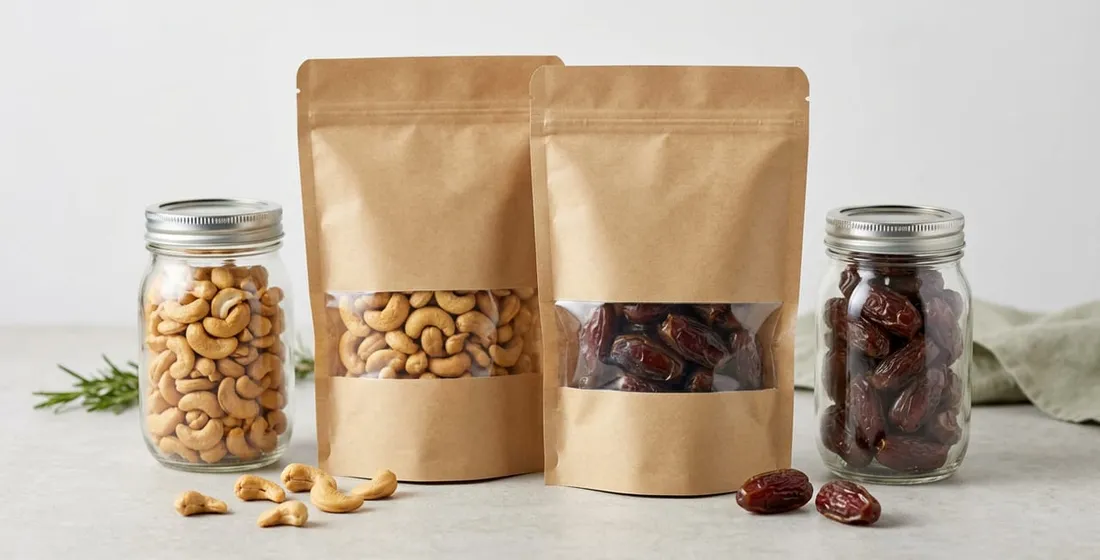
A distributor who has just cleared a container of raw or roasted cashews and a pallet of imported dates owns a real asset and a real problem at the same time. The product is sitting in bulk sacks and cartons. The online shelf wants 100 gram and 250 gram retail packs, a tri-lingual label that satisfies a Ministry of Health inspector, and a barcode a marketplace listing can scan. Bulk-to-retail conversion is the gap between the two, and co-packing is how a distributor crosses it without buying a packing line.
Silk Foods Ceylon (SFC) runs a dedicated co-packing capability at its Matale facility for exactly this case: the buyer supplies the finished imported goods, and the SFC team packs, seals, labels, and prepares the SKU for a Sri Lankan retail or e-commerce channel. This post sets out what that engagement covers for imported nuts and dried fruit, what the labelling law now requires for repackaged imports, and how the maths works for a distributor planning a first online listing.
Buyer's snapshot
|
What co-packing actually covers for imported bulk
Co-packing at SFC sits at the back end of the production chain. The distributor brings finished goods (raw or roasted cashews, pitted or whole dates, and similar dried fruit and nuts), and the SFC team handles the packing, the heat-seal, the retail label, and the SLSI submission paperwork that the channel will ask for. The recipe and the sourcing stay with the distributor. The conversion to a shelf-ready or listing-ready SKU moves to the manufacturer.
Format range matters here, because cashews and dates list at different price points and pack weights. SFC packs into brown and white kraft pouches from 50 grams to 1 kilogram, window pouches at the same sizes, glass jars from 50 millilitres to 1 litre, and 60-count bottles where a portion format is wanted. A distributor running cashews at a snack weight and dates at a gifting weight can do both in one consolidated block rather than two separate runs.
The same back-end logic underpins co-packing in Matale more broadly, and the format choices mirror those used for co-packing imported almonds and for kraft-pouch co-packing for distribution.
The labelling law changed, and repackaged imports are squarely inside it
This is the part most distributors underestimate. Sri Lanka’s Food (Labelling and Advertising) Regulations 2022, issued by the Ministry of Health and brought into effect from 1 January 2024 (with a one-year industry extension), replaced the 2005 framework and tightened the rules for packaged food (USDA Foreign Agricultural Service, 2023). Common names must appear in bold in all three languages, Sinhala, Tamil, and English. Seven allergen groups must be declared. For imported food, the country of origin and the importer’s name and address are mandatory.
The detail that catches repackers: when food is imported in bulk and repacked, the label must carry both the date of manufacture and the date of repackaging. A distributor who simply prints the original roaster’s manufacture date onto a Sri Lankan retail pouch is non-compliant from day one. Co-packing under a manufacturer that builds this into the label artwork removes that risk before the SKU ever reaches a listing.
A distributor who imported a 20-foot container of cashews ahead of the festive season once described the problem plainly: the nuts were excellent, the buyers were waiting, and the only thing standing between the container and the online cart was 8,000 retail pouches that nobody had labelled to the new regulation. The packing was not the hard part. The compliant label was.
SLSI, the marketplace gate, and why the audit chain matters
A packaged food SKU going onto a Sri Lankan retail shelf or a marketplace listing meets the SLSI framework. The Sri Lanka Standards Institution runs the product certification (SLS) scheme and a mandatory import inspection scheme covering 122 items gazetted under the Imports and Exports Control Act (SLSI, 2025). Online channels increasingly ask sellers for the same documentation a physical retailer would, because the platform carries reputational risk for what it lists.
Co-packing under a manufacturer that already holds a current audit stack shortens this. The SFC facility carries BRCGS and FSSC 22000 V6 certification, which means the repacker side of the chain is already audited to a standard the major supermarket chains and serious marketplaces recognise. That cert chain is the same trust signal set out in the certification stack for a Sri Lankan FMCG launch. For a distributor, the value is not the certificate on the wall. It is that the audit chain behind the SKU is intact, so a procurement team or a platform compliance check has less to question.
The economics of a first online run
Co-packing economics reward consolidation. A typical SFC co-packing engagement runs as a single-day production block, and a distributor can mix SKUs inside it: cashews at 100 grams and 250 grams, dates at 200 grams and 500 grams, a gift pack at 400 grams, all sealed and labelled in the same window. That keeps the per-unit packing cost down compared with commissioning a separate run for each line.
The pricing logic favours the distributor who plans ahead of demand rather than during it. Sri Lanka recorded its highest-ever customs revenue year in 2025 (Sri Lanka Customs, 2025), and imported nuts and dried fruit move on seasonal curves, with dates in particular spiking around Ramadan. Channel choice shapes the pack format, as covered in where Sri Lankan FMCG sells. A distributor who converts bulk to retail-ready SKUs four to six weeks before the seasonal peak lists into the demand. One who waits until the peak is packing while the window closes.
Service comparison: which engagement fits an imported-bulk distributor
| Question | Co-Packing | Private Labelling | Contract Manufacturing |
| Who supplies the product? | The distributor (finished imported bulk) | SFC (from the ready-to-go catalogue) | The distributor’s recipe, made by SFC |
| What does SFC do? | Pack, seal, label, SLSI paperwork | Relabel an SFC formulation under the buyer’s brand | Manufacture at commercial scale |
| Typical first run | A single-day consolidated block | 1,500 jars or 1,250 bottles per SKU | Format-dependent (1,500 jars and up) |
| Best fit for | Imported cashews, dates, nuts, dried fruit | A brand that wants a product without formulating | A brand with its own recipe to scale |
For a distributor sitting on imported cashews and dates, co-packing is almost always the right door. Private labelling and contract manufacturing solve a different problem (no product yet, or a recipe to scale), which is why the cluster keeps them on separate posts.
Packaging formats for nuts and dried fruit
| Format | Sizes | Typical use |
| Kraft pouch (brown or white) | 50 g, 100 g, 250 g, 500 g, 1 kg | Cashew snack packs, bulk dates |
| Window pouch | 50 g to 1 kg | Premium nut and date retail packs |
| Glass jar | 50 ml to 1 L | Gifting and shelf-stable presentation |
| Bulk sack with inner liner | 25 kg, 50 kg | Wholesale and B2B channel resale |
Frequently asked questions
What does co-packing for imported cashews and dates include at Silk Foods Ceylon?
The distributor supplies the finished imported bulk, and the SFC team packs, heat-seals, applies the retail label, and prepares the SLSI submission paperwork. Formats run from 50 gram to 1 kilogram kraft pouches and glass jars up to 1 litre, usually inside a single-day consolidated production block.
Do imported repackaged foods need new labelling under Sri Lankan law?
Yes. The Food (Labelling and Advertising) Regulations 2022, effective from 1 January 2024, require tri-lingual common names, seven allergen declarations, the country of origin, and the importer’s details. For bulk imported food that is repacked, both the date of manufacture and the date of repackaging must appear (USDA Foreign Agricultural Service, 2023).
Is SLSI clearance needed to sell repackaged imported food on a Sri Lankan e-commerce marketplace?
Packaged food is covered by the SLSI framework, including a mandatory import inspection scheme across 122 gazetted items (SLSI, 2025). Marketplaces increasingly request the same documentation a physical retailer would, so a co-packer with a current audit stack shortens the compliance check before a listing goes live.
What is the minimum order for a co-packing run at SFC?
Co-packing typically runs as a single-day production block rather than a fixed unit MOQ, which lets a distributor consolidate several SKUs into one run. Capsule and portion-bottle formats follow a 180-bottle minimum per SKU. The structure rewards planning ahead of seasonal demand.
How large is the Sri Lankan e-commerce opportunity for repackaged retail SKUs?
Sri Lanka’s e-commerce market was valued at roughly USD 2.65 billion in 2025 and is projected to reach USD 3.2 billion by 2029 (ecommerceDB, 2025). Nuts and dried fruit are a steady online grocery category, particularly around seasonal gifting peaks.
How Silk Foods Ceylon can help
For distributors converting imported bulk (almonds, cashews, dates, oats, spices) into Sri Lankan retail-ready SKUs, Silk Foods Ceylon (SFC) operates a dedicated co-packing capability at the Matale facility. The buyer supplies finished goods; the SFC team handles packing, labelling, and SLSI submission support under the Sri Lanka Food Act labelling framework. Packaging options span 50 gram to 1 kilogram kraft pouches, glass jars from 50 millilitres to 1 litre, and 60-count bottles. The BRCGS and FSSC 22000 V6 cert stack on the repacker side reassures the major supermarket chains and marketplace procurement teams on the audit chain.
To brief a co-packing or consolidation plan, email b2b@esilkroute.com.lk or call +94 76 441 0389 / +94 76 918 5744.
Sources
- USDA Foreign Agricultural Service (2023), “Sri Lanka Enacts New Legislation for Food Labeling and Advertising”, https://www.fas.usda.gov/data/sri-lanka-sri-lanka-enacts-new-legislation-food-labeling-and-advertising (retrieved 2026-06-02).
- Sri Lanka Standards Institution (2025), “Product Certification Scheme (SLS Mark) and import inspection scheme”, https://slsi.lk/en/services/systems-certification/ (retrieved 2026-06-02).
- Sri Lanka Customs (2025), “National Imports Tariff Guide 2025”, https://www.customs.gov.lk/customs-tariff/ (retrieved 2026-06-02).
- Cashew Corporation of Sri Lanka (2025), “Raw Cashew Import Application 2025”, https://www.cashew.gov.lk/ (retrieved 2026-06-02).
- ecommerceDB (2025), “E-Commerce Industry in Sri Lanka”, https://ecommercedb.com/markets/lk/all (retrieved 2026-06-02).
Silk Foods Ceylon (Pvt) Ltd manufactures, private-labels, and co-packs food and wellness SKUs from its cellular-manufacturing facility at Silk AgTech Park, Hapugasyaya, Nalanda, Matale, Sri Lanka. For B2B project briefs, contact b2b@esilkroute.com.lk.